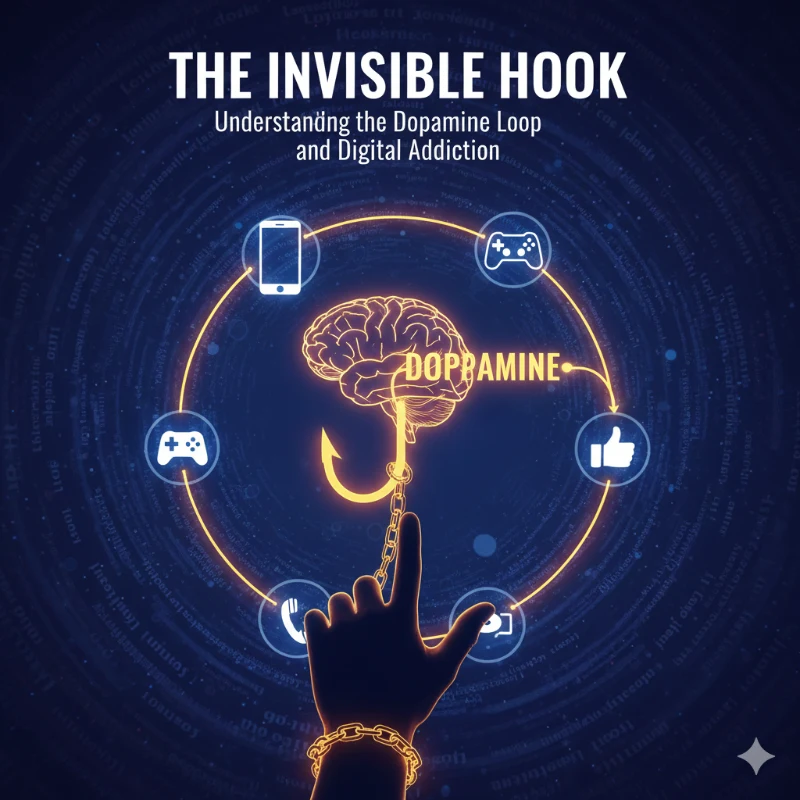
The Invisible Hook: Understanding the Dopamine Loop and Digital Addiction
Have you ever picked up your phone to check a single notification, only to find yourself scrolling through reels or newsfeeds forty minutes later? You aren't lazy, and you aren't lacking willpower. You are caught in a "Dopamine Loop." Modern technology is designed to target your neurobiology. Once you understand the Neurobiology of Smartphone Addiction, you can take your focus back.
1. What is Dopamine? (The Reward Seeker)
Contrary to popular belief, dopamine isn't just about "pleasure." It’s the chemical of anticipation. It’s the brain's way of saying, "Something good might happen next!"
In nature, this helped us find food. In 2025, this is what keeps you clicking. Every "like," "match," or "new video" releases a tiny hit of dopamine. This creates a cycle: you seek, you find, you feel a brief high, and then you seek again. This is the Dopamine Loop and Digital Addiction in action.
2. The "Slot Machine" in Your Pocket
Why is social media so addictive? Engineers use a psychological concept called Variable Rewards, also known as The Slot Machine Effect in Apps.
If every scroll gave you a boring post, you’d stop. But because only some scrolls give you something funny or shocking, your brain stays hooked on the "maybe." This constant stimulation is one of the primary Scientific causes of short attention span. When your brain gets used to 15-second bursts of high excitement, focusing on a book or a project feels physically painful.
3. The Cost: Impact of Instant Gratification on Focus
When we live in a state of high dopamine, our "baseline" changes. Things that used to be fun (like a walk in the park) start to feel dull.
Mental Fog: Your brain becomes exhausted from processing thousands of micro-stimuli.
Anxiety: Constant notification "pings" keep your nervous system in a state of high alert.
Focus Decay: You lose the ability to engage in "Deep Work"—one of the most common Effects of high dopamine on mental health.
4. The Solution: How to Reset Your Brain Reward System
The good news? Your brain is "plastic"—it can change back. You don't have to delete all technology, but you do need boundaries.
Try a "Dopamine Fast": Follow a Dopamine Fasting for Beginners guide by picking a few hours a day to avoid all digital screens. Let your brain get "bored" again.
Grey-Scale Your Phone: Removing bright colors makes apps like Instagram look much less appealing to the brain.
The 20-Minute Rule: Before opening an app, wait 20 minutes. Often, the "itch" for the dopamine hit will pass.
Practice Digital Minimalism: Delete apps that don't add value and turn off all non-human notifications.
Dr. Vertika Kulshrestha: Understanding how social media rewires the brain is the first step toward freedom. You are the master of your attention, not the apps on your home screen. By intentionally slowing down, you allow your brain’s chemistry to stabilize, bringing back the focus and peace you’ve been missing.