the words "Brain Tumor" still carry a heavy weight of fear. However, our understanding of this condition has transformed. We no longer view a brain tumor as a single disease, but as a complex map of cellular changes that requires a highly personalized approach.
Whether it’s a primary tumor (starting in the brain) or secondary (spreading from elsewhere), early detection and understanding the "why" behind the symptoms are your most powerful tools.
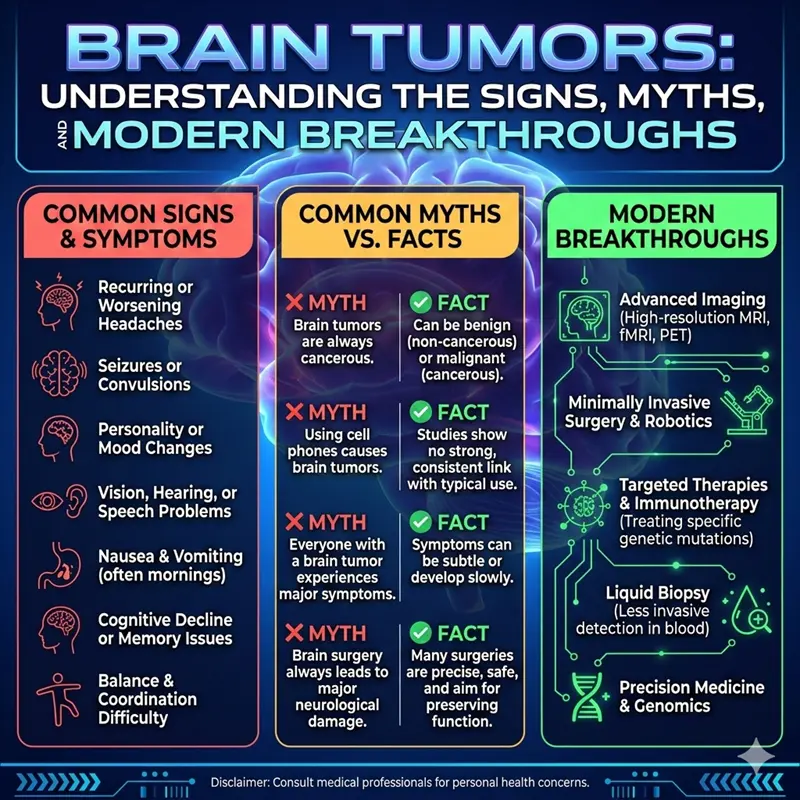
Brain Tumors: Understanding the Signs, Myths, and Modern Breakthroughs
A brain tumor is essentially a mass of abnormal cells. Because the skull is a rigid space, any extra growth can put pressure on sensitive areas, leading to symptoms that can often be mistaken for everyday stress or aging.
1. The Symptoms: When Should You Actually Worry?
Not every headache is a tumor, but the pattern matters more than the pain itself.
The Morning Headache: A classic sign is a headache that is worst first thing in the morning and improves once you’re up and moving.
Seizures: If an adult with no history of epilepsy suddenly has a seizure, it is a primary reason for a brain scan.
Personality Shifts: Sometimes the first sign isn't pain, but a subtle change in mood, judgment, or social behavior—often linked to the frontal lobe.
Sensory Changes: Unexplained blurred vision, hearing loss on one side, or sudden clumsiness (loss of balance).
2. Benign vs. Malignant (The Perspective)
we focus on the molecular profile rather than just the "grade."
Benign (Non-cancerous): These grow slowly and don't spread. However, in the brain, even a "benign" tumor can be dangerous if it presses on vital centers like the brainstem.
Malignant (Cancerous): These are aggressive and invade surrounding tissue. Modern treatments now target the specific genetic mutations within these cells to stop them from multiplying.
3. The "Mobile Phone" Debate: Safe or Not?
One of the most frequent questions is: Do mobile phones or 5G cause brain tumors?
The Reality: After decades of research involving millions of people, there is still no consistent scientific evidence linking cell phone use to brain tumors.
The Human Approach: While the risk is statistically negligible, if you are concerned, use "hands-free" mode or wired earphones to keep the device away from your head—it’s a simple way to gain peace of mind without the anxiety.
4. Breakthroughs in 2026: The Hope
We are moving away from "one-size-fits-all" chemotherapy.
Proton Therapy: A precise form of radiation that destroys tumor cells while leaving the healthy surrounding brain tissue untouched.
Liquid Biopsies: Scientists can now sometimes detect tumor markers through a simple blood test or spinal fluid, avoiding risky brain surgeries just for a diagnosis.
Immunotherapy: Training your own immune system to recognize and attack brain tumor cells.
Dr. Vertika Kulshrestha- If you or a loved one are experiencing persistent, worsening neurological symptoms, do not rely on "Dr. Google." The brain is incredibly resilient, but it is also time-sensitive. Early imaging (like an MRI) can be the difference between a complicated journey and a successful recovery. Stay informed, but stay grounded in facts—not fear.