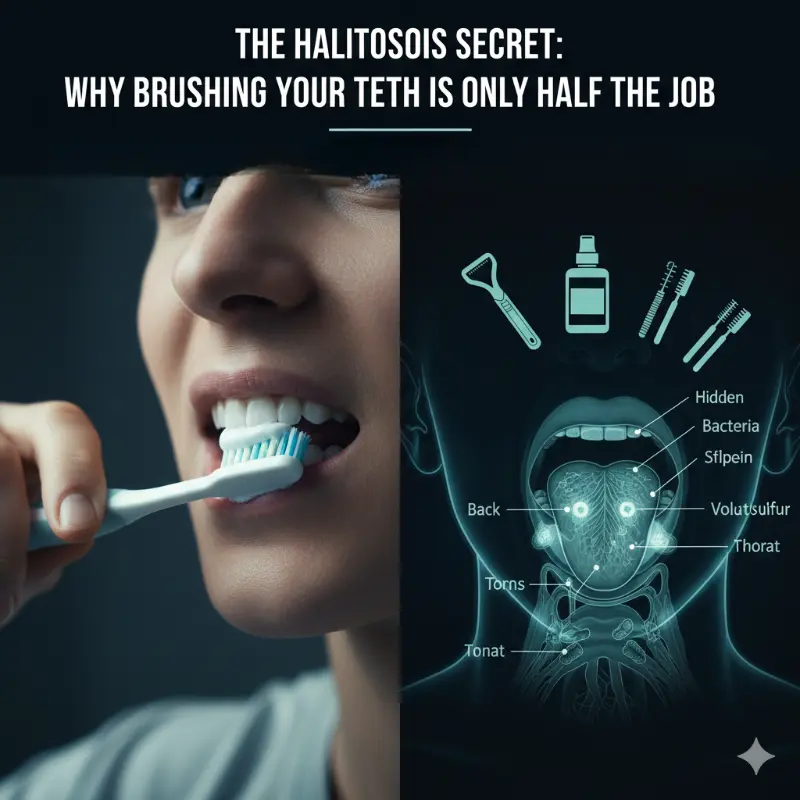
The Halitosis Secret: Why Brushing Your Teeth Is Only Half the Job
Wake up, brush your teeth, and head out the door—sounds like a perfect routine, right? Yet, by noon, you’re noticing people leaning back when you speak. You check your breath in your palm, and there it is: that stale, metallic, or sulfur-like odor.
we’ve realized that Bad Breath (Halitosis) is rarely about the teeth; it’s almost always about the "hidden carpet" in your mouth—your tongue.
You can scrub your enamel until it shines, but if you aren't cleaning your tongue, you’re leaving behind 80% of the bacteria in your mouth. Let’s look at why your breath might still be betraying you and how a simple piece of metal or plastic can fix it.
1. The "Carpet" Problem
If you look at your tongue in the mirror, it’s not smooth. It’s covered in tiny bumps called papillae. These act like a deep-pile carpet, trapping food particles, dead cells, and millions of sulfur-producing bacteria.
The Result: These bacteria break down proteins and release Volatile Sulfur Compounds (VSCs). This is the scientific name for "garbage breath."
2. Tongue Scraping:
For years, people just brushed their tongue with a toothbrush. But now, dental experts agree: Scraping is superior to brushing.
Why? A toothbrush just moves the "gunk" around the bristles. A scraper actually lifts the biofilm off the tongue and removes it from the mouth.
The "Morning Gunk" Test: If you see a white or yellowish coating on your tongue in the morning, that is a layer of bacteria. Scraping it off once a day can reduce bad breath markers by up to 75%.
3. Hidden Causes: It’s Not Always the Mouth
If you scrape your tongue and floss daily but the smell persists, your body might be trying to tell you something else:
The Gut Connection: Issues like Acid Reflux (GERD) or an imbalance in gut bacteria can send odors upward.
Post-Nasal Drip: If you have allergies or sinus issues, mucus drips down the back of your throat, providing a "feast" for bacteria on the back of your tongue.
Dry Mouth (Xerostomia): Saliva is your mouth’s natural mouthwash. If you breathe through your mouth or are dehydrated, bacteria thrive.
4. Safe or Not: Can You Over-Scrape?
Is it safe to scrape every day? Yes, but with a gentle hand.
The Risk: Your tongue is a sensitive organ. If you scrape too hard, you can cause micro-tears or damage your taste buds.
The Method: Always scrape from the back to the front. Use 3–5 gentle strokes. If it hurts, you’re pressing too hard.
Dr. Vertika Kulshrestha :- Avoid alcohol-based mouthwashes; they dry out your mouth and actually make bad breath worse in the long run. Stick to a saltwater rinse or a pH-balancing wash.